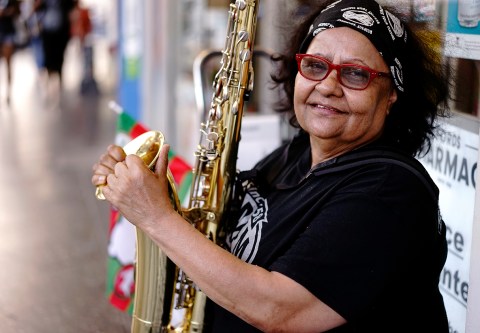
‘I’ve been a homeless alcoholic on the streets. I’ve been an addict walking the streets when I was 16 years old up at the Cross and there were no real outlets to get help then. I think one of the strong contributing factors of depression is when you isolate yourself. You can’t isolate when you feel bad. Just pick up the phone; it’s not a backbreaking thing to do. We have the technology now – mobile phones; the internet. There are support programs anywhere and everywhere. There are phone numbers advertised on TV. You know, Beyond Blue and all that.

‘When I was younger, there was nothing you know. I just got barely through by the skin of my teeth; I really did. It was really hard dealing with depression then. There are better support avenues out there now. You need to talk to someone. Even if you’ve got one friend, one is better than none – there is always someone around.

‘Busking is like my best anti-depressant. It fills that void. It’s a guarantee that every single time I go busking, I go home feeling on top of the world. It’s always 100% guaranteed.’

Supporting Mental Health Week 5-12 October.

Seek help at Beyond Blue.
‘I love music. I can’t play so I feel like I need to organise musicians instead! I do all the logistics in booking bands for festivals and gigs. I make sure the bands show up and know what time they’re playing.

‘It’s good to see local festivals and events pop up – the local scene gets encouraged and they look for local bands. It’s really great. The international bands have cornered the market a little bit and people need to see that there are still great bands in Australia and that they need to get out there.’


‘I’m a Professor of Geography at Sydney University and a Newtown resident since 1989. I’m doing a lot of work on global food security issues, nutrition, links with climate change and the environment.’

What kind of trends are you seeing at the moment?

‘My sense is that there are a lot of problems. It’s a pretty grim future. There are problems regardless of climate change in terms of feeding upwards of 9 billion people by the year 2050. And the environment is becoming more degraded and we’ve got a more uncertain climate. These are big issues that there are no easy answers for.’

From a local perspective, what can individuals do?

‘There is a lot of good stuff that’s happening. I think part of the answer is to be more resilient which means a bit more local food – supporting local businesses. I think the old model of big companies shipping food around the world is becoming less reliable in the future. I think we have to rely on more local production. The Inner West is a great place for local start-up businesses in the food and beverage industry. Some restaurants do local sourcing. There are of course urban gardens, community gardens, backyard gardens – a lot of things happening around this place. If it can happen in the Inner West, it can happen anywhere!’