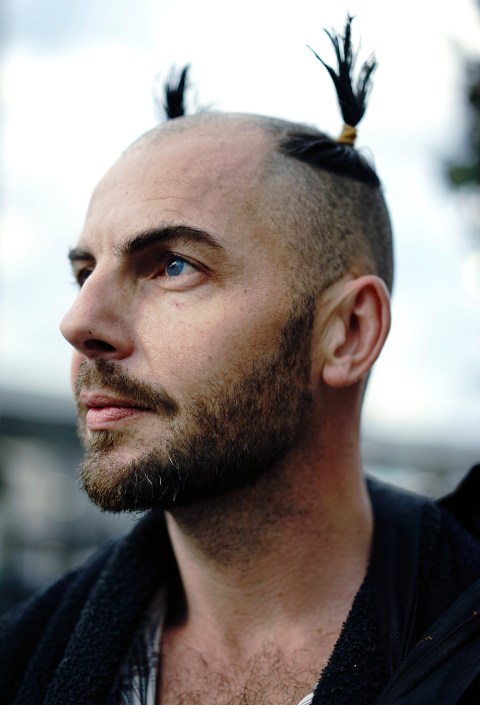
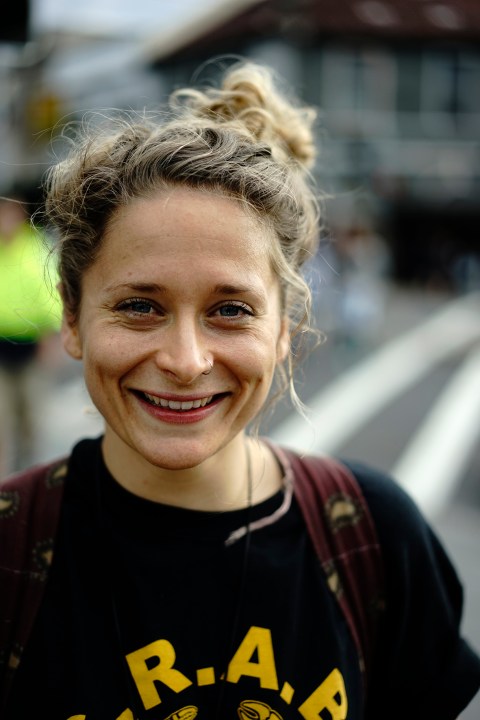
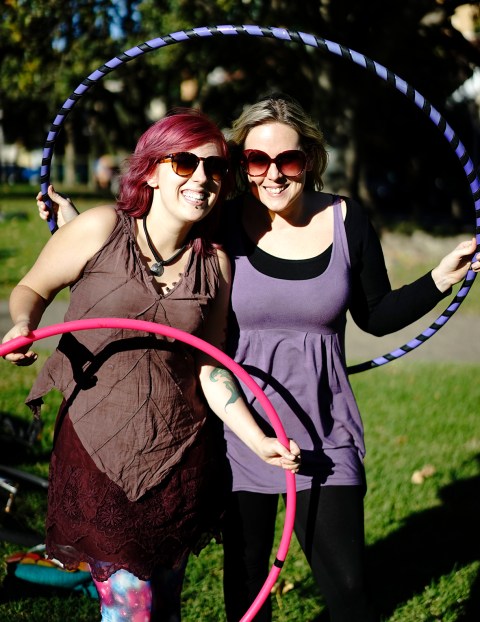
‘We met at a hoop class about a year ago and have been coming to the park to practice our moves and learn a few new ones. I’m now going to help her with the Sunday Streets project.’

‘Sunday Streets is a little plan that some colleagues and I are hatching to close down parts of Enmore Road to recreation on a Sunday morning every couple of months. I’ve asked her if she’d like to be involved and maybe run a hoop workshop.

‘The biggest part of it is about transforming the roads that are usually for cars and making sure that it’s a community space for a while we’re people can come out and meet each other and transform the space. It’s got so many benefits – health, environmental, economic and for the community. The businesses do really well out of it too. It gets people out on the streets alfresco shopping.

‘It’s something that happens in 100 capital cities around the world including Chicago, New York, Cape Town and Jakarta. Los Angeles closes off 25km of roads every couple of months. It’s an international movement but it’s not happening in Australia yet.

‘We plan to connect up some existing cycle routes so cyclists can get a good ride in with activity stations along the way. So it’s very safe for families as well as rollerbladers and skateboarders.

‘The plan is to bring people together from different communities and interest groups. It’s about celebrating diversity and subcultures.’

‘I want to go to England and open a gallery in London with the world’s largest painting. It’s a magical portal between the worlds with a very magical subject.’

How big is the painting?

‘About six storeys. We’ll paint it on canvas in Dublin and offer it to the English as a peace offering. I can’t say right now which building we plan to put it on but it’s an old power station.

‘We’re going to bring some of Princess Diana’s energy back to a world that needs it.

‘The whole ethos behind the gallery is to take art away from the elitist club and to celebrate and promote art of ordinary people. Such as exhibitions of portraits painted with materials of canvas provided by the gallery to the disabled, the homeless, elderly, people with terminal illness – anyone you can think of who Diana supported during her time here.

“’he idea is to bring art to the public through the people who popular culture likes to sweep under the rug and pretend that they’re not there. The gallery is more about infusing our culture with a sense of self-worth based upon what we can create within ourselves as an individual but also as a collective.

‘It will be called the Princess of Whales Gallery (as in dolphins and whales). If Sea Shepherd or anyone else wants to come along and offer their support and be supported in return then they’re welcome to approach us.’

What’s one memory that you hope you never forget?

‘It’s more of a feeling than a particular memory. I hope I can remember forever the feeling of being on stage and making people laugh. Definitely.’

‘I grew up in an era in the 1980s where you’d leave the Sutherland Shire and come in to the city and see half a dozen bands on the way. Poker machines came in the 1990s and destroyed the music industry in Sydney. We’re here to revitalise it.

‘We’re protectors of our heritage so to speak. I personally think that it’s my obligation as an owner of the building to see it live on for the next generation and generations to come.

‘We’re in the process of looking at about four Australian companies that are interested in leasing it.’

Is there anything in particular that whoever gets the contract, you would like to see the do?

‘As long as they’re Australian and they keep it live entertainment here whether it’s theatre, Vaudeville or whatever.

‘Three stipulating points – the back outside wall will belong to the artist (who just completed his artwork today) for as long as he can paint and the other artists that have used that wall – they’re Australian. They have to use the painter that I’ve commissioned to paint the building and my electrician because he knows it inside out.

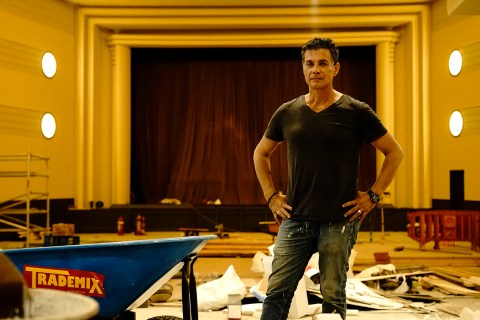
‘The huge ceiling lights took us about two months each to restore. In 1999 a hailstorm went through this place and did close to $700,000 worth of damage to everything. It was a swimming pool down here. We never really restored the lights properly – we just sort of temporarily restored them. We’ve spent so much money here now doing the restoration, we decided to spend some time on the lights. We got geniuses in plaster work and basically remoulded them, fixed them up and rewired them. They’re all LED now. That’s the only thing that’s changed in here simply because the first three on each side used to come down to the ground so you could change the globes and then they would be winched back up. We didn’t want them touched any more. If there’s loud music in here we don’t want them rattling and falling down. They’re an important part of the architecture in here.

‘The architect that built this place is responsible for around 2,000 buildings in Sydney. He built the Grace Bros Broadway building. The Hub falls in to the P&O style where the patron would come to the cinema and get ‘taken away’ on a boat. Hence the round circles at the top and the front. They’d come in here and they’d feel like they were going away on a cruise. People needed escapism so theatre was killing it back then.

‘I’m enjoying the work here. It’s our building so it’s a labour of love. I’ve been working on it for two years now. Why wouldn’t you do it up? It’s such a beautiful building.’

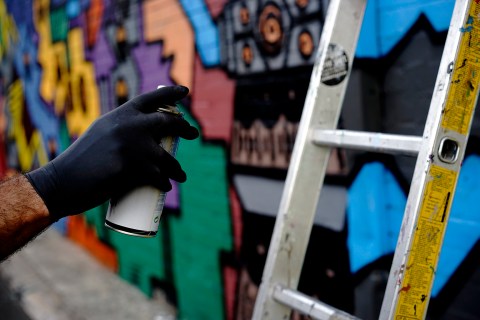
‘Unfortunately there is a lack of respect for this kind of art in Australia compared to other countries in the world. I’ve been doing this for 25 years now and if I’d been doing it overseas – somewhere like in Europe – I’d probably be famous by now.’